Platform overview
One platform, four connected parts
Customers rent through the app, operators run the business from the management console, and vehicles are reached through a connected vehicle layer. The Ridee platform sits in the middle and keeps all three in sync.
Customer App
iOS and Android app for finding, unlocking and paying for a vehicle.
Ridee Platform
Rentals, pricing, customers, vehicles and tenant data in one backend.
Operator Management Console
Web console for fleet, rentals, customers, pricing and access control.
Connected Vehicles / IoT
Provider-based layer that carries commands and device data between Ridee and the vehicle.
Customer App
The app your customers rent with
An iOS and Android app that is part of the Ridee platform — it shares the same rentals, pricing and vehicle data your operators see in the management console. It can be published under your own brand.
01
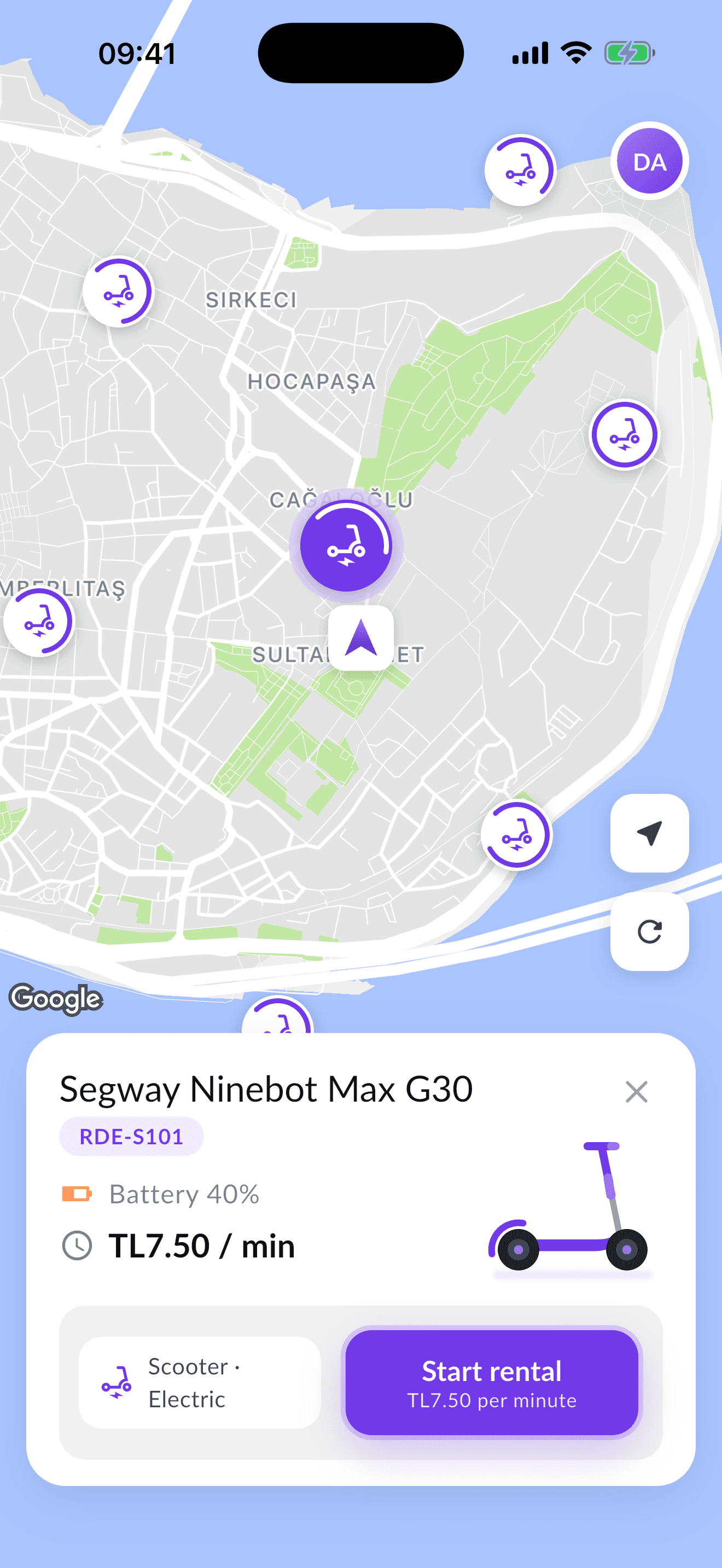
Home
See vehicles on the map, tap one to view its battery and price.
02
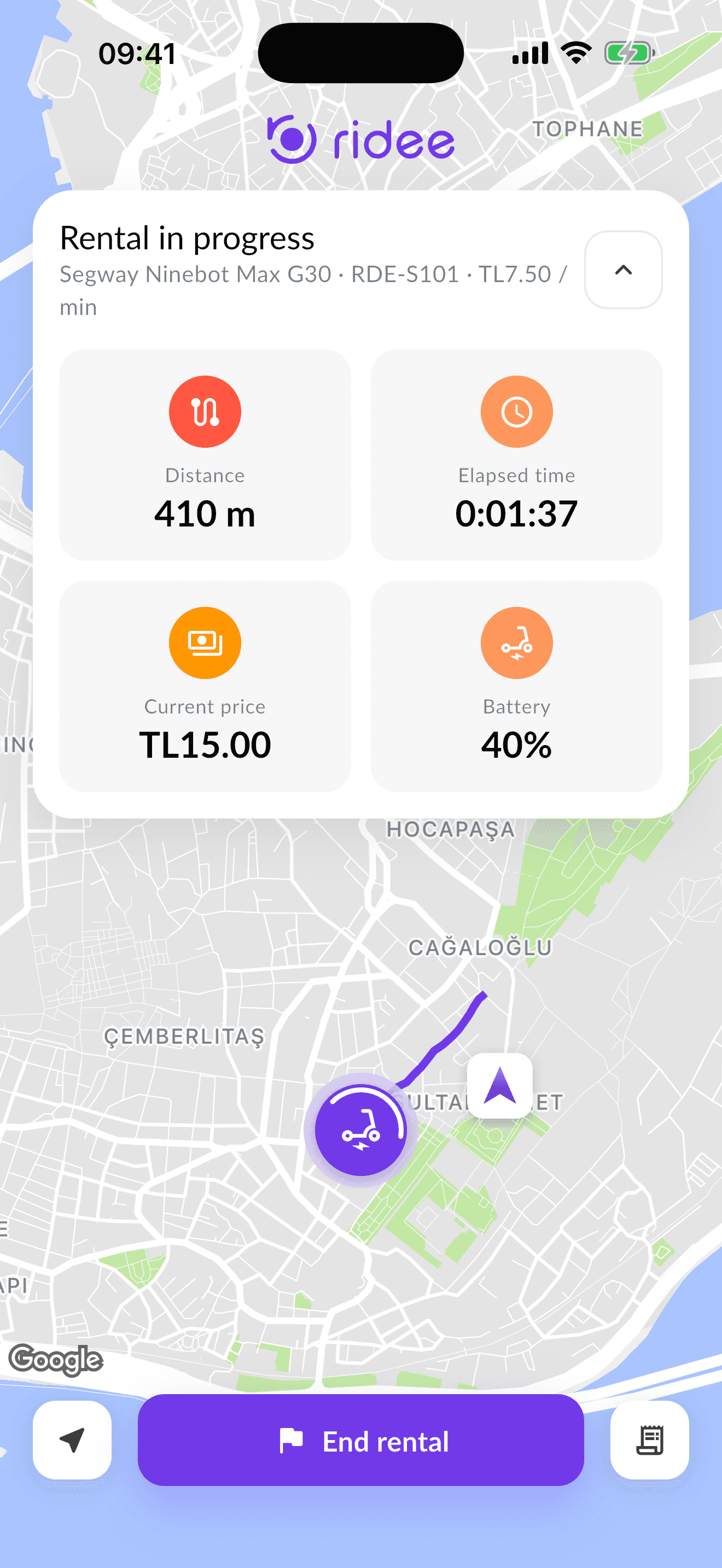
Start ride
One tap starts the rental; time and price run live.
03
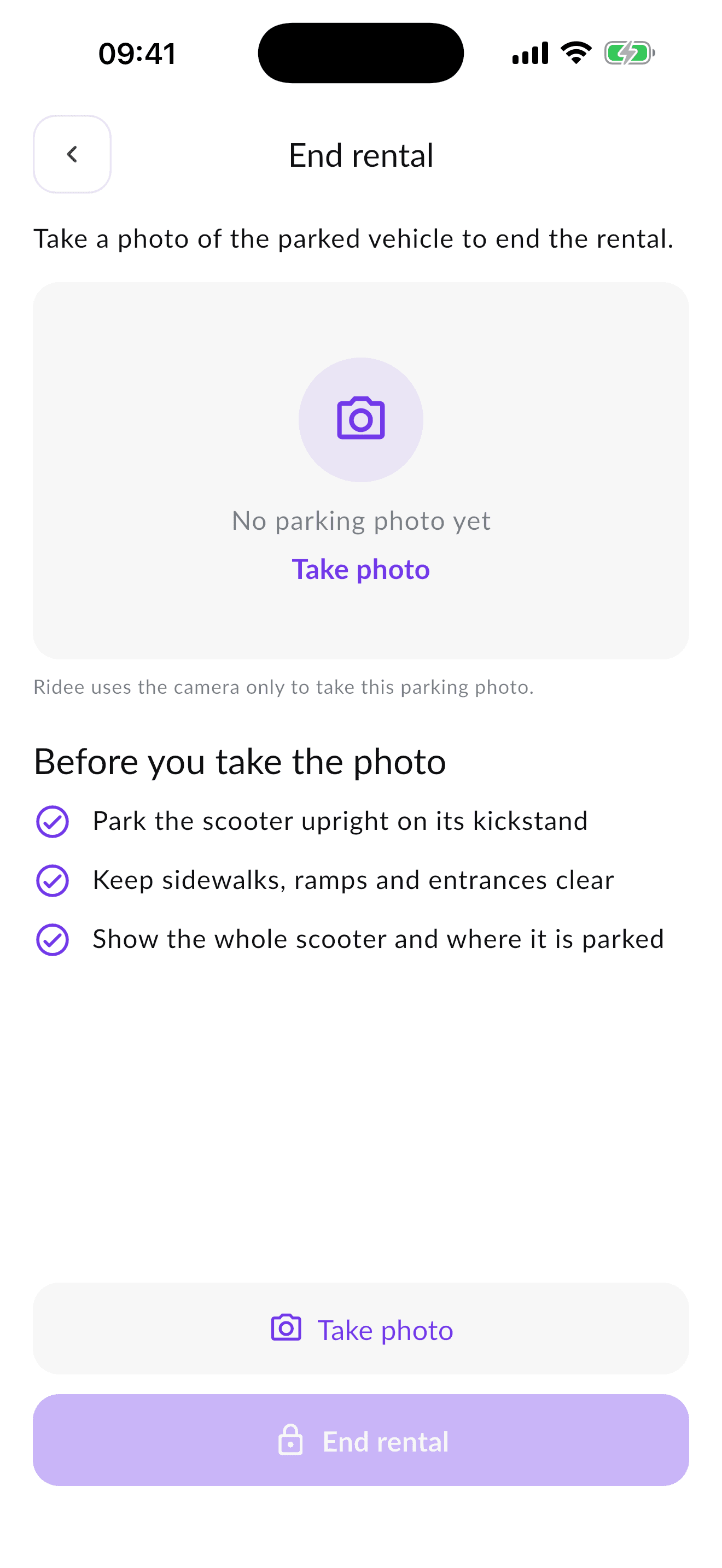
End & park
A photo of the parked vehicle is required to finish.
04
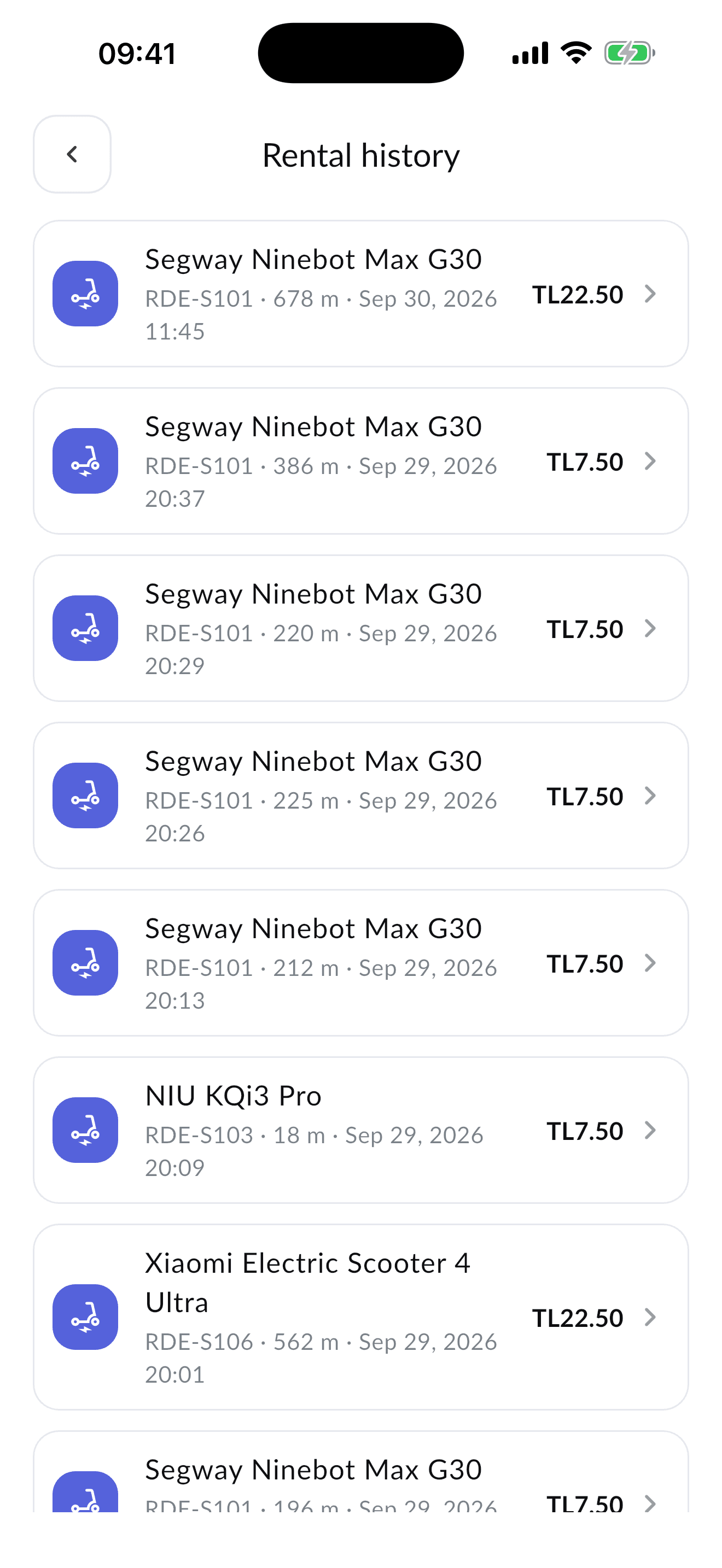
My rides
Every past ride with its vehicle, distance and price.
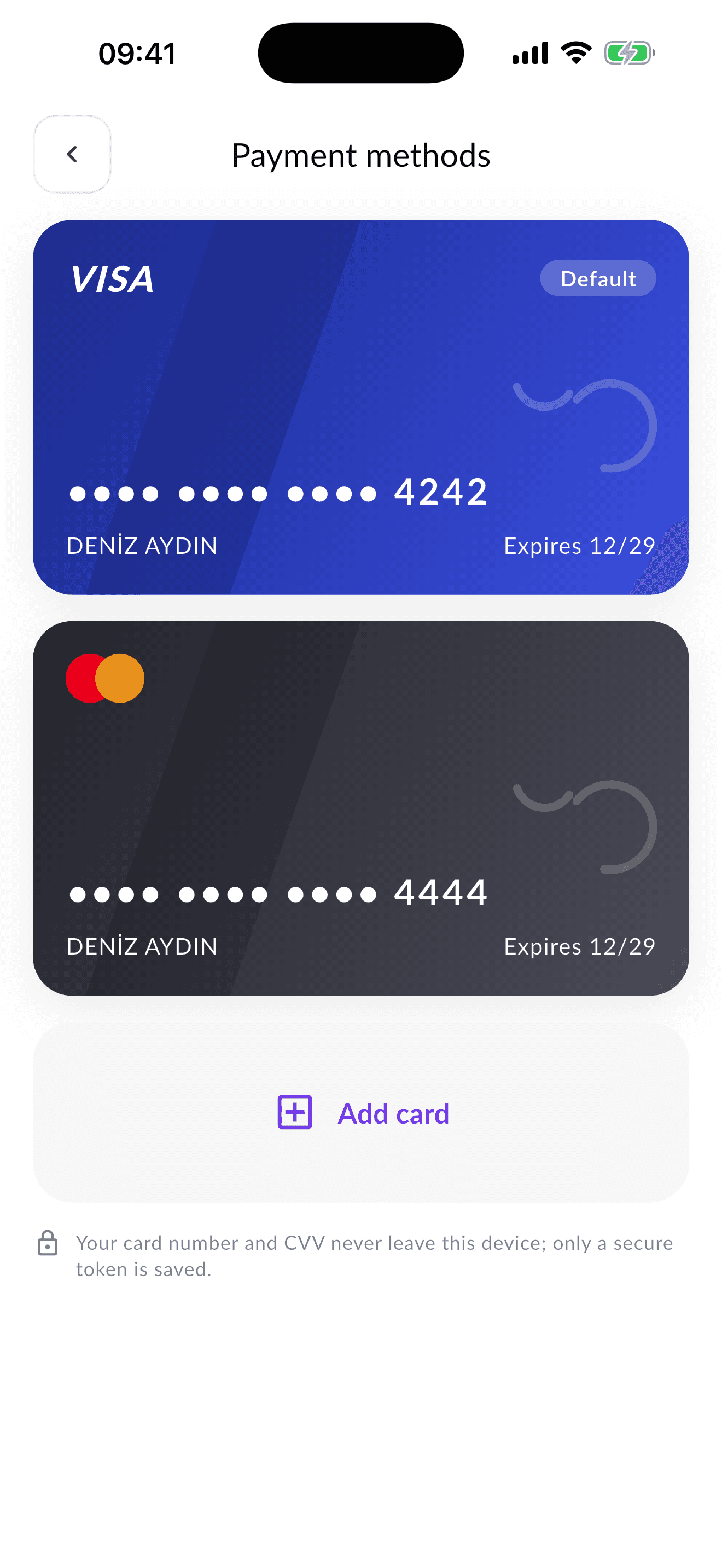
05
Payment methods
Saved cards and add card.
What is in the app today
- Phone number sign-in with SMS code
- New customer registration and session restore
- Map, GPS location and nearby vehicles
- Vehicle detail and rental start
- Active rental with elapsed time and running price
- Mandatory end-of-rental photo
- Receipt, My Rides and ride detail with route
- Profile, saved cards and add card
- English, Turkish, German, French, Spanish, Russian and Arabic
Operator Management Console
Run daily operations from one console
The web management console gives your team a live view of vehicles, rentals and customers, and control over pricing and who can do what.
Every vehicle on a map with its current state, battery and lock status.
Fleet visibility
Dashboard and fleet map show where vehicles are and what state they are in.
Vehicle management
Add, edit, activate, deactivate and retire vehicles; mark them for maintenance.
Rental operations
Rental list and detail with pricing, route, photos and IoT timeline.
Customer management
Customer list and detail, rental history, and read-only view of saved cards.
Pricing
Pricing and currency settings are configured in the management console.
IoT command visibility
Command history per vehicle shows what was sent and what was acknowledged.
Users, roles, permissions
Give each team member access to the areas they need.
Realtime updates
Operational screens update as rentals and vehicle states change, without refreshing.
Fleet management
Know the state of every vehicle
Ridee keeps a registry of your vehicles and their operational state, so your team works from one source of truth.
Vehicle registry
Each vehicle has its own record with details and history.
Fleet map
See vehicle positions and states on a map.
Availability and state
Available, in rental, in maintenance or deactivated.
Maintenance state
Take a vehicle out of service and bring it back when ready.
Connected vehicle data
IoT command history is shown on the vehicle record.
Rental management
Every rental, fully traceable
Open any rental and see what happened from start to finish.
- Customer
- Vehicle
- Rental status
- Start and end time
- Pricing
- Route
- End-of-rental photos
- IoT events
- Payment state
Payments run through a provider-independent payment layer; the payment provider is agreed and integrated per deployment.
Rental lifecycle
How a rental works
The same flow runs end to end across the app, the platform and the vehicle.
Find
Nearby vehicles on the map
Select
Vehicle and payment method
Unlock
Ridee sends the unlock command and waits for acknowledgement
Ride
Elapsed time and running price
End
Customer ends the rental
Photo
Required photo, then the vehicle locks
Receipt
Final price and ride history
Connected vehicles / IoT
Your fleet. Your hardware.
Ridee is not tied to a single IoT vendor. Its provider-based architecture lets different IoT integrations run within the same fleet while the rental experience stays the same.
Teltonika
FTC305 · TFT100
Comodule
IoT Platform Integration
Custom IoT
Additional provider and vehicle-controller integrations
Not locked to one IoT provider
The rental platform is not hard-coded to one hardware manufacturer.
Different devices in one fleet
Each vehicle is assigned its own IoT device and provider, so vehicles of the same operator can use different IoT solutions.
Need another IoT provider?
The provider-based architecture is designed for additional hardware and platform integrations, without rewriting the rental platform.
Consistent rental experience
Customers and operators see the same flow whichever device is on the vehicle.
What the layer is designed to carry
- Location / GPS
- Connectivity
- Telemetry
- Battery
- Vehicle commands
- Command acknowledgement
- Device status
Supported IoT integrations: Teltonika, through a native protocol implementation covering device registration, IMEI-based identification, device assignment and management, telemetry, location, connectivity state and the command infrastructure. The implemented Teltonika device profiles are FTC305 and TFT100, which share the same gateway and can run side by side. Comodule is integrated as an IoT platform through Comodule's Server API. Vehicle control capabilities such as lock and unlock are mapped according to the connected vehicle and controller, so the data and commands available depend on the specific device and vehicle.
Vehicle types
Designed for more than scooters
Ridee is built to support short-term rental of different connected vehicles on the same platform.
E-scooters
E-bikes & bicycles
Motorcycles & mopeds
Cars
Snowmobiles & snow scooters
Other connected rental vehicles
Suitability for a specific vehicle depends on its connected device and controller. We review this with you during the demo.
Platform foundations
Built for operators, teams and tenants
Realtime operations
Management console screens receive live operational updates as rentals and vehicle states change.
Access and security
Phone + one-time code sign-in for customers, role-based management console access with permissions, and protected customer media.
Multi-tenant by design
Each operator works in its own isolated tenant with its own vehicles, customers, pricing and users.
Multilingual
The customer app and management console are available in English, Turkish, German, French, Spanish, Russian and Arabic.
Deployment
The easy way to run Ridee
Ridee runs on Ridee Cloud. No servers to set up, no infrastructure to maintain — you focus on your fleet.
Ridee Cloud
Hosted by usYour operation runs as its own tenant on the Ridee-hosted platform. The fastest way to go live.
- Hosted and operated by Ridee
- No servers or installation on your side
- Platform updates included
- Your own isolated tenant
Security built in
Isolated tenant data
Vehicles, customers, rentals, devices and users are kept per tenant; one operator never sees another's data.
Two-factor sign-in
Management console users can protect their accounts with an authenticator app code.
Roles and permissions
Each team member only sees and changes what their role allows.
Brute-force protection
Sign-in attempts are rate-limited and accounts lock after repeated failures.
Secure sessions
Sign-in codes and session tokens are stored only as hashes; changing a password ends existing sessions.
Protected customer media
End-of-rental photos are served only to the customer who took them and authorised console users.
Packages
Packages that follow the stage of your business
Core Ridee functionality is the same in every package. What changes is operational complexity, integration and IoT requirements, onboarding and support. Pricing is agreed per project.
START-UP
For businesses launching or validating a shared mobility operation.
The complete Ridee platform on Ridee Cloud with a standard setup.
- Customer App and Operator Management Console
- Core rental lifecycle
- Fleet, vehicle, customer and rental management
- Pricing configuration
- Standard supported IoT integration
- Ridee Cloud deployment
- Standard onboarding and support
SCALE-UP
For established operators expanding their fleet, markets and operational complexity.
Everything in START-UP, with more help on integrations and operations.
- Support for more complex fleet operations
- Advanced roles and permissions setup
- Multi-provider and more complex fleet integration requirements
- Additional integrations with integration assistance
- Expanded operational configuration
- Assisted onboarding
- Priority support
ENTERPRISE
For larger organisations with tailored integration, infrastructure or operational requirements.
Everything in SCALE-UP, shaped around your organisation.
- Custom IoT, OEM and vehicle-controller integrations
- Custom business integrations
- Tailored configuration
- Enterprise onboarding and implementation assistance
- Enterprise support arrangements
Compare packages
| Capability | START-UP | SCALE-UP | ENTERPRISE |
|---|---|---|---|
| Customer App | Included | Included | Included |
| Operator Management Console | Included | Included | Included |
| Fleet management | Included | Included | Included |
| Rental management | Included | Included | Included |
| Pricing & currency settings | Included | Included | Included |
| Realtime operations | Included | Included | Included |
| Localization (7 languages) | Included | Included | Included |
| Your brand on the customer app | Available | Available | Available |
| Users / roles / permissions | Standard | Advanced | Advanced |
| Connected vehicles / IoT | Standard | Multi-provider | Custom / OEM |
| Integration support | Standard | Assisted | Tailored |
| Custom business integrations | — | Optional | Available |
| Onboarding | Standard | Assisted | Enterprise |
| Support | Standard | Priority | Custom arrangement |
Frequently asked questions
Ridee is a shared mobility and short-term vehicle rental platform. It consists of a customer mobile app, an operator management console, a rental backend and a provider-based connected vehicle layer.
E-scooters, e-bikes and bicycles, motorcycles and mopeds, cars, snowmobiles and other connected rental vehicles. Suitability for a specific vehicle depends on its connected device, which we review with you.
Ridee uses a provider-based IoT architecture, so the rental platform is not tied to one manufacturer and different integrations can coexist in the same fleet. Teltonika is supported with the FTC305 and TFT100 device profiles, and Comodule through its IoT platform integration. Remote vehicle commands depend on the capabilities of the selected IoT hardware and the vehicle controller. Other providers and OEM hardware are handled as integration work per project.
Yes. The customer app can be published under your brand as part of your Ridee setup.
No. Ridee is delivered on Ridee Cloud: hosting, maintenance and platform updates are handled by Ridee, and your operation runs in its own isolated tenant. You only need your vehicles and IoT devices.
There is no public price list. Packages are scoped to your operation and we prepare a proposal after a demo.
Planning or growing a shared mobility operation?
Let's look at Ridee together.